

Introduction
Choosing between Free Zone vs Mainland UAE is one of the most important decisions investors must make when planning a business setup in UAE . Understanding the difference between both will help entrepreneurs choose the right setup according to their business needs and requirements.
Both options can provide access to UAE’s business ecosystem, international markets, infrastructure and diverse customer base. However, they differ in areas such as market access, licensing structure, office requirements, business activities, regulatory requirements and the way a company operates within the UAE.
Choosing between Free Zone vs Mainland in UAE should therefore be based on the nature of the business and its long-term plans rather than simply choosing the option with the lowest initial setup cost.
This guide explains the major differences between a free zone trade license and a mainland in UAE helping investors understand which option may be more suitable for their business.
Investors who are new to business setup in UAE, can also read our guide on how to start a business in UAE. This guide will be extremely helpful for investors who are new to business setup in UAE on how to start a business in Dubai before exploring the difference between Free Zone vs Mainland in UAE.
What Is a Mainland Trade License?
A mainland company is a business licensed to operate within the mainland jurisdiction of the emirate. In Dubai, mainland business licensing falls under the relevant economic authority and allows businesses to conduct permitted commercial activities within the wider UAE market, subjected to the applicable licensing and regulatory requirements.
A mainland structure can be particularly suitable for businesses that expect to work directly with customers across Dubai and the UAE, establish a physical presence, participate in local projects or expand their operations within the domestic market.
One of the significant changes in the UAE business environment is the availability of 100% foreign ownership for many mainland commercial companies, subject to the applicable activity and regulatory requirements. Investors should still verify the ownership rules for their specific activity before establishing the company.
The mainland route can therefore provide considerable flexibility for investors whose business model depends on serving customers throughout the UAE.
What Is a Free Zone Trade License?
A free zone company is established within one of the UAE’s designated free zones. Dubai has several free zones designed around different sectors and business models, including trading, technology, media, logistics, financial services and other specialized activities.
A free-zone trade license can be attractive to investors who want to establish a UAE business with a structure focused on international trade, specialized activities, professional services or operations within the relevant free-zone framework.
Free zones can also offer investors different packages covering licensing, office space, visas and other business setup services. The exact requirements and benefits vary from one free zone to another.
Therefore, it is important not to treat every free zone as identical. The most suitable free zone depends on the business activity, target customers, location requirements and operational plans.
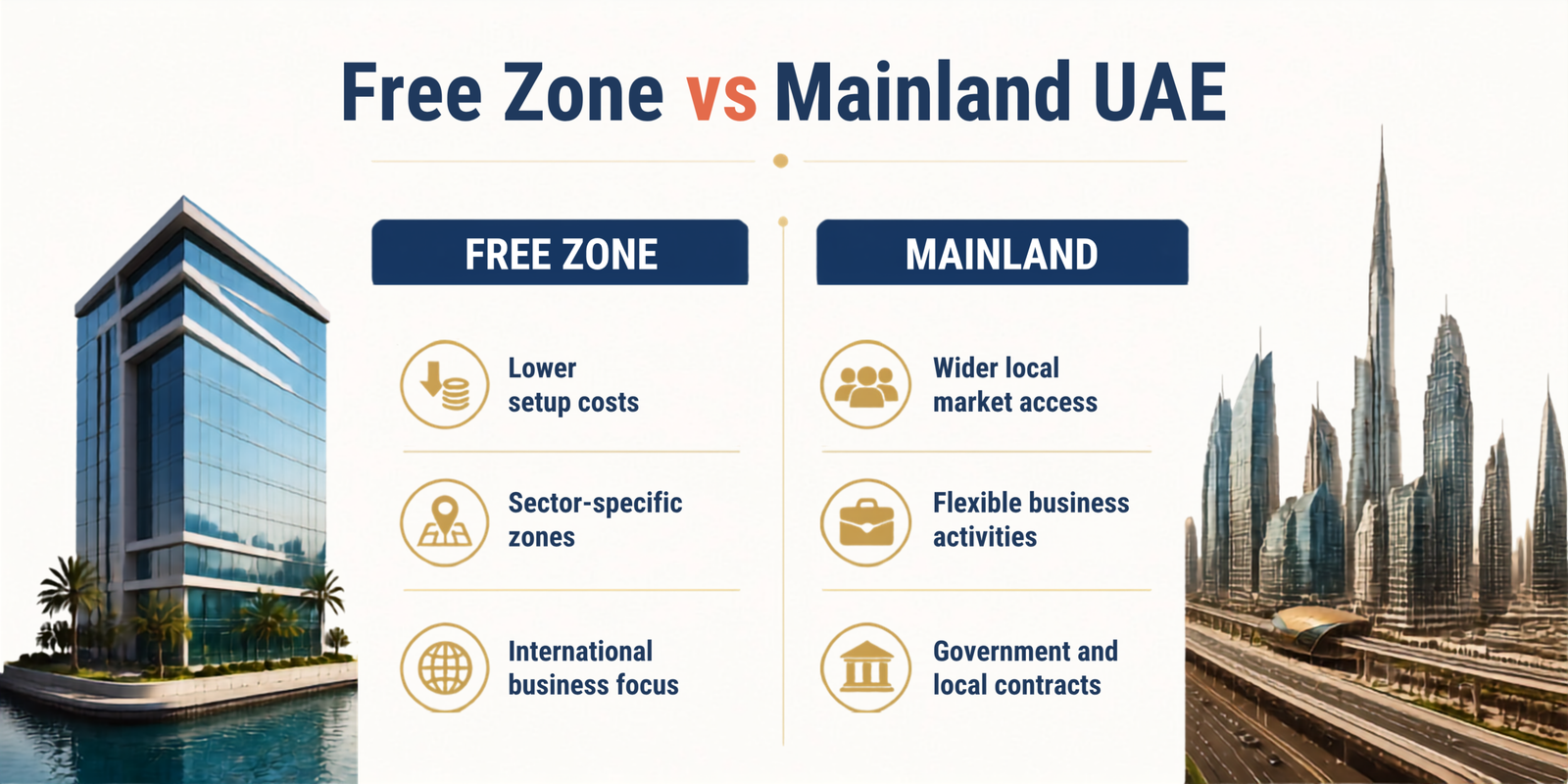
Free Zone vs Mainland: What Is the Difference?
When comparing Free Zone vs Mainland, investors should look beyond the headline licensing fee.
The right choice depends on how the company intends to generate revenue, where its customers will be located and how the business plans to grow.
Here are some of the most important factors to consider.
Access to the UAE Market
A major factor in selecting the right trade license is identifying the ideal location for your business and then analyzing whether the location is a Free Zone or the Mainland in the UAE.
A mainland company is generally structured for operating directly within the UAE domestic market, making it a natural option for businesses that expect to deal extensively with local customers, companies and projects.
A free-zone company can conduct business from its free-zone jurisdiction and engage in permitted activities with international and other free-zone customers. However, businesses planning to conduct activities in the mainland may need to comply with additional requirements depending on the nature of the activity and the applicable regulations.
For an investor whose main customers are expected to be UAE-based companies or consumers, mainland setup may therefore offer greater operational convenience.
For a business primarily focused on international clients, specialised services or free-zone operations, a free-zone structure may be more appropriate.
Foreign Ownership
Foreign ownership is another important consideration for international investors.
The UAE has significantly expanded opportunities for foreign investors to own businesses. Many mainland commercial activities can now be established with 100% foreign ownership, subject to the relevant rules.
Free zones have also historically been popular among international investors because they provide ownership structures designed for foreign entrepreneurs and investors.
However, ownership should not be the only reason for choosing a jurisdiction.
An investor should also consider the company’s intended activity, customers, physical operations and future expansion plans before deciding between the two.
Business Activities
The type of business you want to establish can strongly influence the right licensing option.
A mainland license may be suitable for businesses that need to operate broadly across the UAE domestic market.
Free zones, meanwhile, often provide specialized licensing options designed around particular industries and business models.
For example, an investor establishing a technology, media, consultancy, trading or logistics company may find that certain free zones offer specialized infrastructure and business services relevant to the sector.
Before selecting a jurisdiction, investors should confirm that the intended business activity is available under the proposed license and understand any additional approvals that may be required. Therefore, the type of business an entrepreneur wants to establish plays a crucial role in choosing between Free Zone v/s Mainland in UAE.
Office and Location Requirements
Location is another important consideration for a Dubai investor.
Mainland businesses can establish offices in different areas of Dubai, subject to the applicable tenancy and licensing requirements. This can be advantageous for companies that need to be physically accessible to customers, suppliers or employees across the city.
Free zones can provide office solutions within the relevant free-zone jurisdiction. Depending on the free zone and license package, options may include shared workspaces, flexi-desk arrangements, serviced offices or dedicated premises.
For a small startup, a flexible office package may be sufficient initially. A growing company, however, may eventually need a larger physical office, warehouse or specialized facility.
The investor should therefore consider not only today’s office requirements but also where the business expects to be two or three years from now. These factors help investors decide whether Free Zone vs Mainland in UAE is the right trade license option for their business.
Business Costs
Cost is often the first factor investors consider when comparing Free Zone vs Mainland in UAE but it should not be the only factor.
The total cost of setting up a business can include:
- Trade license fees
- Registration fees
- Office or workspace costs
- Visa-related expenses
- Establishment card fees
- Government approvals
- Activity-specific approvals
- Accounting and compliance costs
- Renewal fees
- Other operational expenses
Free zones may offer attractive startup packages, but the total cost varies significantly depending on the free zone, license type, office arrangement and number of visas required.
Similarly, mainland setup costs vary depending on the business activity and operating requirements.
Instead of comparing only the advertised license price, investors should calculate the total cost of ownership for the first year and subsequent renewal years.
Therefore along with location, business costs also play a crucial role in determining whether to choose Free Zone vs Mainland UAE.
Expansion Within the UAE
Consider where you want the business to be in the future.
If your business model requires frequent interaction with UAE customers, local companies, construction projects, retail customers or government-related opportunities, a mainland structure may provide a more convenient foundation for domestic expansion.
A free-zone company can also grow significantly, particularly when its business model is focused on international clients, specialised services, trading or activities compatible with the free-zone framework.
The important question is not simply, “Which license is cheaper?”
Instead, ask:
Which license will make it easier for my business to achieve its five-year growth plan?
This approach can prevent investors from choosing a structure that looks inexpensive initially but becomes inconvenient when the company expands.
Is a Free Zone License Better for Startups?
A free-zone company can be an attractive option for startups, particularly when the founders want a relatively focused business environment and do not immediately require extensive mainland operations.
For example, a consultant, technology entrepreneur, digital service provider or international trading business may find a free-zone setup suitable depending on the activity and chosen jurisdiction.
Free zones can also provide business support ecosystems, networking opportunities, office solutions and sector-specific infrastructure.
However, startups should avoid assuming that every free zone offers the same benefits.
The founder should compare:
- Available business activities
- License type
- Office requirements
- Visa options
- Renewal costs
- Banking considerations
- Customer location
- Future mainland requirements
- Tax and compliance obligations
A lower initial setup cost does not automatically mean a lower long-term business cost.
Is a Mainland License Better for Growing Businesses?
A mainland license may be particularly attractive for businesses that want to establish a strong presence in Dubai and serve the UAE domestic market.
Businesses involved in areas such as professional services, contracting, retail, construction-related activities, local services and other domestic-facing operations may benefit from the flexibility of a mainland structure, depending on the specific activity.
For a business planning to build a UAE customer base, recruit a larger local workforce and establish multiple physical locations, mainland setup can provide a practical foundation for expansion.
Again, the exact licensing requirements depend on the activity. Thus, entrepreneurs must choose Free Zone vs Mainland UAE by considering the business activity, business cost, location and the long-term goals which they want to achieve in future.
What About Corporate Tax?
Corporate Tax is an important factor when evaluating Free Zone vs Mainland UAE, but investors should be careful about assuming that a free-zone company automatically pays no Corporate Tax.
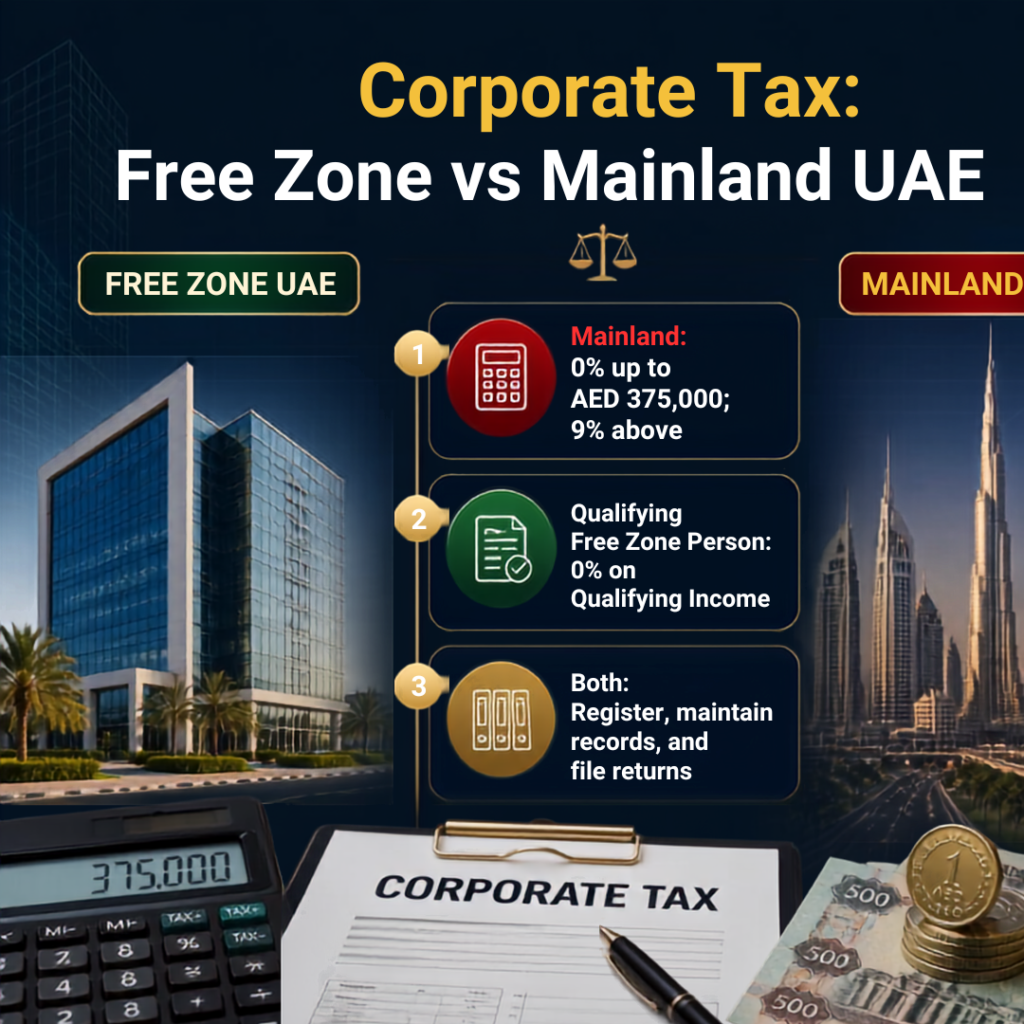
Under the UAE Corporate Tax framework, free-zone companies are within the scope of Corporate Tax. A Free Zone Person that meets the conditions to qualify can benefit from a 0% Corporate Tax rate on qualifying income. Other taxable income can be subject to the applicable UAE Corporate Tax rules.
The UAE Ministry of Finance has also updated the rules concerning qualifying and excluded activities. Ministerial Decision No. 229 of 2025 replaced the earlier decision and clarified the scope of qualifying activities for free-zone Corporate Tax purposes.
This means investors should not choose a free zone solely because they have heard that “free-zone companies are tax-free.”
Instead, the investor should determine whether the company’s activities and income meet the conditions applicable to the Free Zone Corporate Tax regime.
Mainland businesses are also subject to the UAE Corporate Tax framework. The standard Corporate Tax rate is 0% on taxable income up to AED 375,000 and 9% on taxable income above that threshold, subject to the applicable legislation and rules.
Professional tax advice should be obtained where the business structure or income streams are complex. For detailed corporate tax regulations and qualifying income criteria , investors can refer to the Federal Tax Authority’s official Corporate Tax resources.
For more details, businesses can refer to the Federal Tax Authority website.
Free Zone vs Mainland : Which One Should You Choose?
There is no single answer that works for every Dubai investor.
A free-zone trade license may be worth considering if:
- Your business is focused on international clients.
- You want to operate within a specialized free-zone ecosystem.
- Your intended activity is well suited to the selected free zone.
- You require a flexible startup structure.
- You do not immediately need extensive mainland operations.
- The free zone provides infrastructure relevant to your industry.
A mainland trade license may be worth considering if:
- Your primary customers are in the UAE.
- You want to operate extensively across Dubai or the wider UAE.
- Your business requires a physical location accessible to local customers.
- You plan to expand your domestic operations.
- Your activity is better suited to a mainland structure.
- You expect to work on projects or contracts requiring a mainland presence.
The best decision depends on the individual business model.
Five Questions Every Dubai Investor Should Ask Before Choosing
Before applying for a license, ask yourself these five questions:
Who are my customers?
Are they mainly UAE-based customers, international clients, free-zone businesses or a combination?
Where will I operate?
Will you work from an office, warehouse, retail location, studio or virtually?
What activity will I conduct?
The exact activity can affect the available license options and approvals.
Where do I want the company to be in three to five years?
Your initial structure should support your growth rather than restrict it.
What will my total annual cost be?
Look beyond the first-year promotional package and consider renewal, office, visa, compliance and operational costs.
Answering these questions can make the decision between a free-zone and mainland setup much clearer.
Common Mistakes Investors Should Avoid
Choosing a business jurisdiction based entirely on price is one of the most common mistakes.
An investor may find an attractive license package and immediately proceed without checking whether the jurisdiction supports the company’s intended customers and operations.
Another mistake is assuming that a free-zone license automatically provides unrestricted access to the mainland market.
Investors should also avoid choosing a license before clearly defining their business activity. The license should reflect what the company actually intends to do.
Finally, tax assumptions should be verified against the current UAE Corporate Tax rules rather than relying on outdated information or generic claims about “tax-free” free zones. Thus, an investor should keep all these factors in mind before choosing the right license between Free Zone vs Mainland UAE.
Conclusion
The decision between Free Zone vs Mainland UAE is ultimately a business strategy decision, not simply a licensing decision.
A free-zone company can be an effective choice for investors seeking a specialized business environment, international operations or a structure aligned with the activities offered by a particular free zone.
A mainland company can be a strong option for businesses targeting the UAE domestic market and planning to build a broader presence across Dubai and the wider UAE.
For a Dubai investor, the best approach is to start with the business model, target customers and growth plans, and then select the jurisdiction that supports those objectives.
Before making the final decision, investors should also verify the current licensing, ownership, tax and regulatory requirements applicable to their specific activity. Thus, understanding the difference between Free Zone vs Mainland UAE helps investors make informed business setup decisions.
Frequently Asked Questions (FAQs)
1. Is it better to start a business in a Free Zone or Mainland in Dubai?
It depends on your business activity, target customers and growth plans. A Mainland company can be suitable for businesses targeting the UAE domestic market, while a Free Zone company may be more suitable for international clients, specialized activities or businesses operating within a particular Free Zone.
2. Is a Free Zone company tax-free in the UAE?
Not automatically. Free Zone companies are subject to UAE Corporate Tax. A qualifying Free Zone Person may benefit from a 0% Corporate Tax rate on qualifying income if the applicable conditions are met. Investors should assess their specific business activities and income against the current Corporate Tax rules.
Pingback: Free Zone Visa Limits: 7 Key Insights for UAE Investors